Tuesday, August 29, 2006

Ephemera


Yesterday evening, I went to read one of the blogs I frequent, and found that it and the blogster who wrote it are both gone. Click.
I was surprised by my reaction. I've seen blogs evaporate before, and all of the warning signs were present in this one. I found myself melancholy and gently stunned by the disappearance. It reminded me of the vanishing city in The Brief History of the Dead.

This ubiquitous happening unceremoniously cut a thread. (Though, I wouldn't complain if more people rose to the courtesy of deleting their blog after the third and final entry that, two years ago, began with "I'm so bored...") I find a "one step back" scenario in my effort to expand my network of writers, poets, philosophers, artists, and daydreamers.
As I looked over the bare grave-marker Profile screen, I thought back to a sweltering July evening, when I was working one of those jobs that paid the tuition for a couple of years but otherwise remains a footnote in the story of my life. I was working at a driving range, and that night found myself cursing the mosquitoes, telling myself that they were infinitely worse than they had been the previous summer. I thought I must surely be imagining this development.
Glancing over my shoulder at the baleful light coming from the tall lamps illuminating the parking lot, I realized that the phenomenon was not imagined. The dominoes in my head started falling over: the new street lights; the parking lot that now covered the half-acre stand of old trees adjacent to the range; the small army of golf ball-sized bats that had lived in the trees; the memory of watching bats diving in and out of the powerful beams of the overhead range lights; the swarms of insects that were lured into the harsh light, only to be devoured. One collapse yielded dozens of changes.
Now, I grumble to myself over the people who would have followed that lost blog to mine. Hubris. Of course, I realize that this is futile. There was no grand destiny for some reader to follow the convoluted series of sharp angles across the web to spend a moment over what I have written. If there had been, they would have gotten here, or may yet by some other route. For now, I read and write and tie more threads.

Wednesday, August 23, 2006

flicker
geometric pegs snap into place
I settle back to sleep

Monday, August 21, 2006

How Far We've Come!

ARC Identifier: 539221
Title: Heart Mountain Relocation Center, Heart Mountain, Wyoming. In the press room of the Cody Enterprise . . ., 01/08/1943


Creator: Department of the Interior. War Relocation Authority. (02/16/1944 - 06/30/1946) ( Most Recent)

Type of Archival Materials:
Photographs and other Graphic Materials
Level of Description:
Item from Record Group 210: Records of the War Relocation Authority, 1941 - 1947

Location: Still Picture Records LICON, Special Media Archives Services Division (NWCS-S), National Archives at College Park, 8601 Adelphi Road, College Park, MD 20740-6001 PHONE: 301-837-3530, FAX: 301-837-3621, EMAIL: stillpix@nara.gov
Production Date: 01/08/1943

Part of: Series: Central Photographic File of the War Relocation Authority, 1942 - 1945

Scope & Content Note:
The full caption for this photograph reads: Heart Mountain Relocation Center, Heart Mountain, Wyoming. In the press room of the Cody Enterprise, Bill Hosokawa, Editor of the Sentinel, Heart Mountain Relocation Center newspaper, grabs the first sheet off the press and scans it for errors. Press work on the Sentinel is done under contract by Enterprise printers. Bill, as editor, prepares the makeup, reads proof, sets type, makes corrections, operates the linotype and locks the forms ready for the press. A Washington U. graduate and former foreign correspondent and west coast reporter, Hosokawa is also an experienced printer and assumes, single handed, the task of seeing that his 8 page tabloid newspaper comes off the press as a first rate sheet.

Access Restrictions:
Unrestricted

Use Restrictions: Unrestricted

Variant Control Number(s):
NAIL Control Number: NWDNS-210-G-E664
Local Identifier: NWDNS-210-G-E664

Copy 1
Copy Status: Preservation
Storage Facility: National Archives at College Park - Archives II (College Park, MD)
Media
Media Type: Negative

Index Terms

Contributors to Authorship and/or Production of the Archival Materials
Parker, Tom, Photographer

Thursday, August 17, 2006

Things scribbled on August 10 from 12:11-12:26

REMEMBER YOUR UMBRELLA, NIMROD.

my Mondrian wall
golden world dances beyond
she took the choice seat

it hides in plain sight
gnarled tree by the coffee shop
leaving life behind

the jackass and the pachyderm are fighting for the crown
six or an even half-dozen
overzealous congressional staffers
wrinkled suits
phones singing Motown to Providence crackers
wasting their brief lives in servitude
liars, salesmen, and big-tent-revivalists
none better than the last
ellipsis

waiting for Godot
Ray rambles schizoid sermons
I seem to be blind

"no more coffee," my watch scolds me. time to go.

Wednesday, August 16, 2006

I know it when I see it

Since attending the MAPS Meet, I’ve been on the lookout for instances of folk culture in my own backyard. In the vulgar suburbs, folk culture doesn’t jump out at you the way all of the basket-making and recipes of “real” folk culture do. It can be very difficult to define, but like Potter Stewart said, “I know it when I see it”.
There I was, riding home on the tube, when I saw it- a piece that has been around almost as long as I can remember, hiding in the light. Amidst all of the other graffiti, ranging from hip-hop pop art to drunken-imbecile-with-a-can-of-paint, was a tag that reached back decades. Like so many before (and I hope so many to come) it read
- Cool “Disco” Dan -
This tag hearkens back to my earliest memories of the train. I don’t recall how old I was, certainly not more than 10, the first time I saw it. Then another, and another. Soon it became one of those childhood rituals, like the punch-buggy game, spotting instances of Disco Dan’s work.
In high school came the last realization that this was not the work of an individual. Some were excellent renditions, perhaps by the master himself, others were poor reflections, clear knock-offs. Teenagers suggested an elaborate Dread Pirate Roberts lineage: “I am not the real Cool ‘Disco’ Dan. The man who gave me the name wasn’t either. The real Disco Dan is retired and living like a king in Cleveland Park…”
Throughout college, I don’t recall having seen a single new application of the tag. Old ones weathered, sometimes becoming so faded that I couldn’t have read them if I didn’t already know where they were and what they said.
As I reminisce over the tag, I realize that this instance is along a stretch of track that I travel every day. Moreover, it is a vibrant plum color that does not bear the mark of age. This is new and wrought in the style of the original ones.
Here, on the Red Line, I see continued a tradition of folk art. Some would call it destructive, and I suppose on some level it is. It must be. It would just be a marketing gimmick if you could buy readymade Disco Dan from Target.
I adjust my sunglasses and puzzle over the people and places that Dan connects.

Tuesday, August 15, 2006

Pneumonic


I look at the polished brass frame around the glass door and see an image that reminds me of one of van Gogh's self portraits. A young man, his short beard framing his cheeks, looks back. His blue eyes pierce me, searching for something, but they are fettered by a force deeper than the holes they dig into me. I feel bad for him. I want to give him the answer he's urgently seeking, but he doesn't even know the question. I take a deep breath.
I study the notebook in front of him. Its dusty-blue cover is worn, the helical wire in its spine flattened in a few places. The pages’ edges fan open a little and reveal scuffs of graphite and a few dots of smeared ink. It seems alive, breathing like a horseshoe crab or a spider.
The book’s owner has only looked up from it a few times since he sat down with his coffee. Mostly he has been writing frenetically, first on one page, then another, sometimes flipping three or four pages backward to cross out a single word or add a line of text. Sometimes he just reads one page over and over.
The author furrows his brow and breathes labored breaths, unable to inscribe as quickly as he writes. This is frustrating. Sometimes searching for an elusive word, he fidgets like an animal too long caged. It is as if the act of pushing pen across page is some Herculean effort that weighs as much upon body as mind.
I sit back finally and find that I am equally out of breath.

Thursday, August 10, 2006

Gnomonic

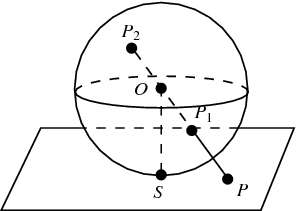
Arcs reach from London Heathrow to cities on the other side of the pond. These aren’t lines that you would be aware of if you were to stand (or tread water) where they pass. Some might call these lines “imaginary”, but I would argue (perhaps splitting hairs) that they are “conceptual”. They exist in peoples’ minds and within tools we contrive. These lines are of the same stuff that allowed the Sphere to show A. Square the insides of his neighbors’ houses.

The arcs’ intended purpose was to estimate the course of aircraft, connecting Europe to the Americas. Business people, scholars, and tourists would conduct across these lines trade, ideas, and single-servings of culture.
These lines were just hijacked. Of course, nobody destroyed an airplane. No one died. Instead, malice of intent has again derailed innocuous plans.
Today on the ride home from work, people looked over their shoulders. I watched two strangers watch a third prod a McDonald’s bag with the tip of his umbrella. One rider, half joking noted that Friday would be 8/11 and that the Madrid and Mumbai bombings had both occurred on the 11th. They way she wrung her fingers as she laughed at this observation belied her cynical calm.
I was reminded of the invisible cord that reaches across minds and oceans and seems to tie our hands and tether us to something moving in an alarming direction. I recalled that connection is like change or difference; there is a tendency to either deify or vilify it.
As the train whined to a halt at the end of the line I stood up and headed home just like I do everyday, one point intersected by so many lines.

Tuesday, August 08, 2006

Mnemonic


Friday afternoon saw me returning to the office from a conference in Dupont Circle. This was before the wind and the rain that washed-away the oppressive heat. The humidity gave the avenues between the hotel and the metro a claustrophobic character and veiled the sky in a diffusive sand-colored glow. As the escalator took me over that rollercoaster angle at the top, a place other than the one right in front of me came into view. Lamp posts became impossibly green trees; brownstones, temples. The algae-covered concrete tube that conveys riders from the brightly-lit circle above to the dim underworld of trains and tunnels below was a cenote. It was, in fact, a particular cenote I had stood above a month before.
The cenotes are, in the most profane geological sense, the result of the action of moving water on the soluble limestone landscape of the Yucatan Peninsula. Ultimately, the water will leave behind an orotund shaft that reaches down to the groundwater level and far beyond. Convoluted networks of underground channels link one cenote to another, and some of these networks even open into the ocean. I've read that some cenotes, miles inland, contain water that tastes of sea salt.
The cenote I recalled at the station, the one within Chichen Itza, is a primitive thing indeed. A circular chasm two hundred feet across, you’d fall six stories from its rim before you got wet. Birds dive into it, but not as far as the opaque green water, while lizards hunt its vertical walls. It is one of those places where the fortress wall that separates the here and now from a harsh old metaphysics fades into a beaded curtain just out of reach. On the one side are sad domesticated men wearing brown knee-socks with sneakers and carrying camera bags, and on the other side, watching, is that primal thing that made building pyramids and cutting a person's still-beating heart from their chest a good idea.
That gaping maw descends not only into the intimate places of the Earth but well past the thin shell of my mind into an unlit vault within. I can only infer what resides there, the thinking layer of words and analysis buffered from it by the ascetic layer of dreams, and impressions, and memories half-remembered.
I thought about posting one of the pictures my wife or I took of the cenote, but that seems totally antithetical to what it is. Even writing about it is not quite right, the thing being described so far removed from the rational part of oneself that arranges letters into words. To understand the cenote I peered into, recall that evacuated state that you may have only experienced a few times, surrounding rage, lust, victory or defeat, or profound loss.
Places like this one connect the visitor to ideas and experiences that are otherwise outside the network of modern consciousness. The computer on the table in the coffee shop or on the desk in the office deny the observer important pieces of the experience.
Once connected by one’s own experience, these memories become entwined into the network in one’s head. From there, they flow unseen beneath the surface into otherwise inane activities, like walking to the train station.

Wednesday, August 02, 2006

A metabiography for Dave

He’s what you might call
a nonstandard kind
of person Once when
I had to return
a book to Hornbake
Library Trombley

he says to me I
wanna stay out here
Finish my coffee
he adds with a nod

When I got back to
where he was sitting
someone was putting
change into his cup

Tuesday, August 01, 2006

Pyre

I spent a little time yesterday evening with a couple of Goode's World Atlases. One is from the 1940's, the other a more recent mint. The old one shows a state called Palestine, that looks like the uninterrupted sum of what the new one calls Israel, the Gaza Strip, and the West Bank, with so many asterisks. The truth of the places and the people living there is so much more complicated than either map can express.


The "conflict" isn't a new one. I tend to think of it as a war unlike any other, raging since before anyone can remember, built upon shifting and sometimes far-flung geography. It is stoked by the opinions, allegiances, and actions of persons outside of the theater-proper, many of whom have no legitimate reason to take sides.
In talking recently about this flame that has fanned itself once more from so many smoldering embers, I heard it again. Someone shrugged and said, "It's such an old conflict. And neither side is blameless. What do you expect?" With that, the speaker absolved a thousand moral failings and excused new excesses, based upon the crimes of the enemies' fathers.
How many have to die before one score equals another? Is there a plan to end the war that doesn't involve something like genocide?
The elephant in the room is the fact that every event in this conflict is the result of a choice- a choice to kidnap or capture soldiers, a choice to respond with force that has ended the lives of more children than men bearing arms, and the spectrum of choices of those outside of the conflict on how to respond. Every time the war is reignited, escalated, or encouraged from afar, someone bears the onus of having chosen war over peace.
No one can decide the outcome of last year's battle or punish someone who died half a century ago. We do, however, have the power to decide if children die tomorrow.

Monday, July 31, 2006

A cartographic aside

The rekindled open war between Israel and Lebanon has prompted me to spend a lot of time with my nose buried in atlases. I post these from some of my favorite sources to lend geographical context, perhaps as much for my own benefit as the reader's.
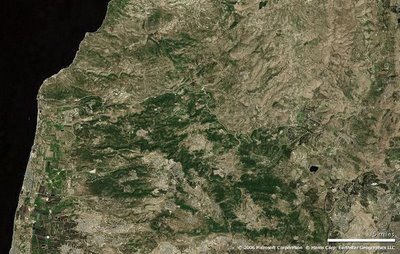
These two are produced by the US Central Intelligence Agency for inclusion in their World Factbook publication. They are not produced to the same scale. A few weeks ago, looking out across the landscape, you might have been hard-pressed to figure out where and why one of these countries ends and the other begins. Everywhere, it would be bright and dry, and you would run into people who spoke Arabic or Hebrew, or both. Many would probably be able to chat with you in English. Roads, though ultimately interrupted by fences, gates, and people equipped and willing to kill, connect cities in the one to cities in the other.


This is a great general map of the Middle East produced by the US National Geospatial-Intelligence Agency (back when it was still the National Imagery and Mapping Agency). I find that it draws-in the relationships of places like Turkey, Iran, Egypt, and Iraq. Not far beyond the edges of this map are India, Serbia, and Dar Es Salaam.

Friday, July 28, 2006

Omission

For whatever reason, I recently had the fever to see names of people I barely knew and their grandparents' names scribbled in hundred year-old books. My employer has a wealth of genealogical resources at the ready, which made the effort almost disappointingly easy. Maybe that’s what incited me in the first place.
My wife's forbearers were easy to follow. A few key strokes, a few clicks of the mouse, and I was looking at the 1790's. Her folks all stayed put, lived in cities, and had respectable jobs.
Not so for my clan. My mother's people all lived down past the ends of dirt roads, and I editorialize from the celerity with which they vanish from record as I go back, didn't care for bureaucrats. Irony.

Following my father's line revealed an interesting riddle, however. He and his half-sister (their relationship in and of itself is an interesting tale, though not mine to tell) know decidedly little about their father's origins. He never said much about his humble beginnings and was, as a more general rule prone to tell things as he saw them or wanted them to be. There were bits of stories about Europe and the occasional, "Semper fi". He was a little too young to have fought in the first World War.
Doing the genealogist jigsaw with all of the "He was from somewhere in New York" or "Kingsport, I'm sure of it" pieces, I found him. There he was in the handwriting of a long-dead census taker, one name sandwiched between so many others.
I had found him, a teenager living with his mother and step father in Bridgeport, CT, Among Austrian-American neighbors whose mother-tongue was listed as “Slavick”. Only he wasn't living with them. Next to my grandfather's name (which had been crossed out) was scribbled the word, "Omit". The only other evidence I had were the words, “Marine” and “U.S.N.”
This piece of the puzzle led to the last piece I could find. A young man with my grandfather's name and birthday had not long before enlisted in the Marine Corps at the New York City recruiter. Only this young man was exactly two years older than my grandfather, and coincidentally, just old enough to enlist.
With this, I did what any real historian would do: interpret, editorialize, and present history as I saw it. The records and the editorial about a young man unwilling to accept a new father filled-in some of the gaps.
This exercise has gotten me thinking about how our personal networks span not just space, but time. Wrapped-up in the convenient package of a database served over the WWW, this pre-digital information system of the US government adds context to a network based upon heritage and genetics. Though, as with most explorations of this sort, the discoveries beg more questions than they answer.

Wednesday, July 26, 2006

Secure


He that would make his own liberty secure, must guard even his enemy from oppression; for if he violates this duty, he establishes a precedent that will reach to himself.
-Thomas Paine

Monday, July 24, 2006

Dharma koan

[I have no time to write and much on my mind.]

If I am not my job, then what am I?

Friday, July 21, 2006

The Lady, Or the Tiger? Or, What is Montague? revisited


This week, I have been busy with concerns of the world outside of the box. Between catching up on all of the work that was displaced by the flood and finishing a term paper on performance management strategies in cultural institutions, I haven't had much time for writing my blog or keeping current with those I read.
Back in the saddle, I'm told that my previous post about the name of my blog was less than helpful. Those persons who told me this might consider creating a blog identity and posting their feelings so that everyone can read them. In my effort to get readers thinking about influence, I apparently "missed" the tangible connection between phrenology and Phrenology. Silly me.
The notion of cursory observation and summary judgment began for me an inquiry into values. I looked for it and found it everywhere: my place of work, my home, my brain, and of course, every time I turned on the television or radio or opened a magazine. In my mind, I began to question and lampoon our snap-judgment and market research culture, connecting it with the dusty pseudoscience.
The blog started out with a grand plan to explore bias and relationships, but almost immediately began to favor the latter. Moreover, the emphasis also quickly became the act of exploration. I learned yet again that I can't get away from geography and that the digital frontier along this undiscovered country of mind, space, and society is too interesting to leave untrodden. I have my chance meeting with Interscape, Silliman's Blog, and a host of blogs by nascent writers to thank for the shift. Of course all of the things happening in the real world had a hand in the shift. The mind (or perhaps the brain) is an inluence machine.
Maybe I'll rename and rebrand Phrenology, and maybe I wont. Maybe I'll get back to the original scheme and maybe I wont. I can't say for sure, because the road ran out a few steps back, and I don't know which way I'm headed from here.

Monday, July 17, 2006

Kantharos and laurel

Today, I'm back "home" at my normal office. The flood has been defeated, and I'm getting tons of work done that has been hampered by the act of God and the ensuing geographical inconvennience.
Despite the fact that I had absolutely nothing to do with getting the building open, I feel victorious. Life is good.
Go forth and declare yourself the Conquering Hero of something today.

Friday, July 14, 2006

Study on "green"

Grassy knoll
wind flips dandelion leaves
verdant
Cabo Verde (ha, it's really brown)
Color of life
stolen by dinoflagellates
algae & lichens
Flavoparmelia caperata
devouring sun and rocks
underfoot + overhead
subduing, creating
tying physics to biology
spinning sunlight and air
into agave and lime
after so many, my complexion
I don’t have enough for a cab
it’s yellow anyway


{why?}

Thursday, July 13, 2006

Good morrow, Werner Heisenberg*

Interscape has been exploring the notion of connectivity. This and my recent travels have me thinking again about interconnection, real and virtual networks, and those Shenandoah falcons. The birds' perch straddles a peculiar ontological line, with one foot in a tangible place, the other dissolved into the web. Whether you consider the WWW to be an inanimate tool or something greater, a confluence of ideas, consciousness, and technology, the falcons are undoubtedly (and unwittingly) part of it.
As they travel and hunt, their nest site is a node. They return there from time to time to eat, to rest, and for other reasons that only make sense to falcons. From it, they connect to other perches, to prey animals, and to sources of water. Each of these interactions careens downhill in a thousand different directions, starting with pathways like small stones falling from high places, rats whose mates never return home, and the uric acid that is a strand in the web of the global nitrogen cycle.
The electronic eyes that beam their image around the world connect them to our web of consciousness. The falcons do not seem impressed by this fact.
I’ve also been looking at the Observer Effect for a graduate class in management I’m taking this semester. In brief, the idea is that by observing something (a system, a behavior, &c), the thing being observed is altered, even if the change is only subtle. This can pose a host of problems for management analysts who are just trying to estimate costs, complete efficiency or job-satisfaction studies, or figure out what in the hell it is that consumers want.
In light of the Observer Effect and the connection of the falcons to the WWW, to me, and to the reader, I’m trying to figure out how we might be impacting the birds and SNP by spying on them.

* Author's Note: E.R. Dunhill is well aware of the distinction between the Heisenberg Uncertainty Principle and the Observer Effect. This is one of those opportunities to be evolved and not nit-pick over cheeky blog devices.

Wednesday, July 12, 2006

Four thousand thirty-two words

Pyramid of Kukulkan.


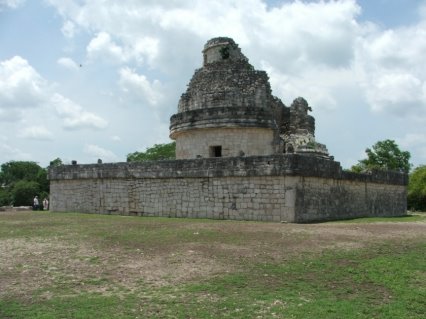
El Caracol. Literally, “the snail” (a reference to the spiral shape of the central structure), this was an astronomical observatory.


Outskirts of town, a few miles from Chichen Itza.


November Niner Seven Fower Delta Lima

bide
engines zoom
lift